Your bedroom is small. Your clothes aren’t. That gap between what you have and what you need, that’s exactly where most Hertfordshire homeowners get stuck.
Most people think a walk-in wardrobe in Hertfordshire is only possible in large houses. That’s simply not true. With the right layout, the right fittings, and a clear budget, even a box bedroom or a landing nook can become a proper dressing space. We’ve helped dozens of local homeowners across Hertfordshire do exactly this and the results speak for themselves.
Here are 6 smart, budget-conscious solutions that actually work.
1. Use the Alcove: It’s Already a Walk-In Wardrobe Waiting to Happen
Most Hertfordshire homes, particularly the older semis and terrace houses across Watford, St Albans, and Hemel Hempstead, have alcoves beside chimney breasts. Homeowners walk past them every day without realizing what’s there.
An alcove that’s 90cm deep and 180cm wide is all you need.
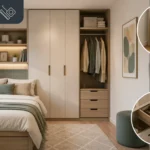
With fitted wardrobes built into that alcove, you get full-height hanging, shelving, and drawer space. Add a sliding door across the front, and suddenly it reads as a dedicated dressing area, not a cupboard.
What this costs: Alcove fitted wardrobe units typically start from around £1,500–£2,500 fitted, depending on the depth and internal configuration. Far less than extending or moving house.
What to ask your fitter: Request full-height carcasses, soft-close drawers, and a mirror panel on one door. Three small changes make a huge difference to the feel of the space.
2. Convert a Spare Room Corner With an L-Shaped Layout
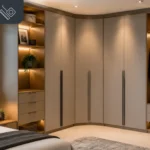
If you have a second bedroom you rarely use or a master bedroom with a dead corner, an L-shaped walk-in wardrobe layout is one of the smartest moves you can make.
You don’t need a whole room. You need roughly 1.5m × 1.5m of floor space.
An L-shaped configuration gives you the following:
- One wall for full-length hanging (dresses, suits, coats)
- A second wall for short hanging plus drawers below
- A corner shelf unit for shoes, bags, or folded knitwear
The result? A functional dressing area that requires no structural work, no planning permission, and no major disruption. Just well-planned walk-in wardrobe units fitted against two walls.
A client in Harpenden had a 3m × 3m spare room that was being used as a dumping ground. We installed an L-shaped fitted wardrobe system along two walls, kept the center clear, and added LED strip lighting, and now they have a full dressing room still with space for an ironing board.
3. Take the Landing: Underused Space With Enormous Potential
Landings are the most ignored room in a Hertfordshire home.
A wide landing with a dormer window or a recessed wall can be transformed into a walk-in wardrobe or dressing area with very little intervention. Because it’s not a bedroom, you’re not losing sleeping space. You’re creating something new from something wasted.
What works here:
- Open-fronted shelving along one side with a curtain rail for privacy
- Bespoke wardrobe units built to fit around the stair bannister or sloped ceiling
- A full-length mirror at the end to make the space feel larger
For sloped ceilings — common in Hertfordshire loft conversions — bespoke wardrobes are the only real answer. Off-the-shelf units won’t fit. A made-to-measure solution uses every centimetre right up to the pitch, giving you storage that a standard wardrobe literally cannot offer.
Bespoke fitted wardrobes average £3,400 for a 2-section unit in 2026 , money well spent when it’s replacing space that was previously doing nothing.
4. Fit Sliding Doors: Save the Space Other Doors Steal
This one sounds simple. It genuinely changes a room.
Traditional hinged wardrobe doors need clearance in front of them to open. In a small room, that clearance is floor space you don’t have. Every time you open the wardrobe, you’re stepping back, shuffling around the bed, or pulling out a drawer first.
Sliding doors solve this entirely.
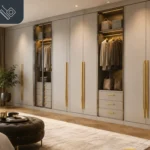
With sliding-door walk-in wardrobe fittings, the door moves sideways across a runner. Zero floor clearance needed. The room instantly feels bigger because the door never intrudes into it.
For small rooms in Hertfordshire, particularly the new-build estates in Welwyn Garden City, Stevenage, and Hertford. This is one of the highest-value changes you can make for the lowest extra cost. Sliding doors typically add £300–£500 to a wardrobe project.
Mirror-fronted sliding doors add another layer of value. They bounce light around the room, make it appear larger, and eliminate the need for a separate full-length mirror.
5. Think Vertically: Floor to Ceiling, Every Time
The biggest mistake in small room wardrobe design is stopping at 2 meters.
Most ceilings in Hertfordshire homes are at 2.4m or higher. That 40cm gap above a standard wardrobe is a dead, dusty, unusable space. Floor-to-ceiling fitted wardrobes reclaim it.
The top section is perfect for:
- Seasonal items (winter coats, summer dresses, holiday luggage)
- Bulky items you rarely need (duvets, spare bedding)
- Archived storage boxes
Meanwhile, the eye-level section does the daily heavy lifting, regular hanging, everyday shoes, and frequently used shelves.
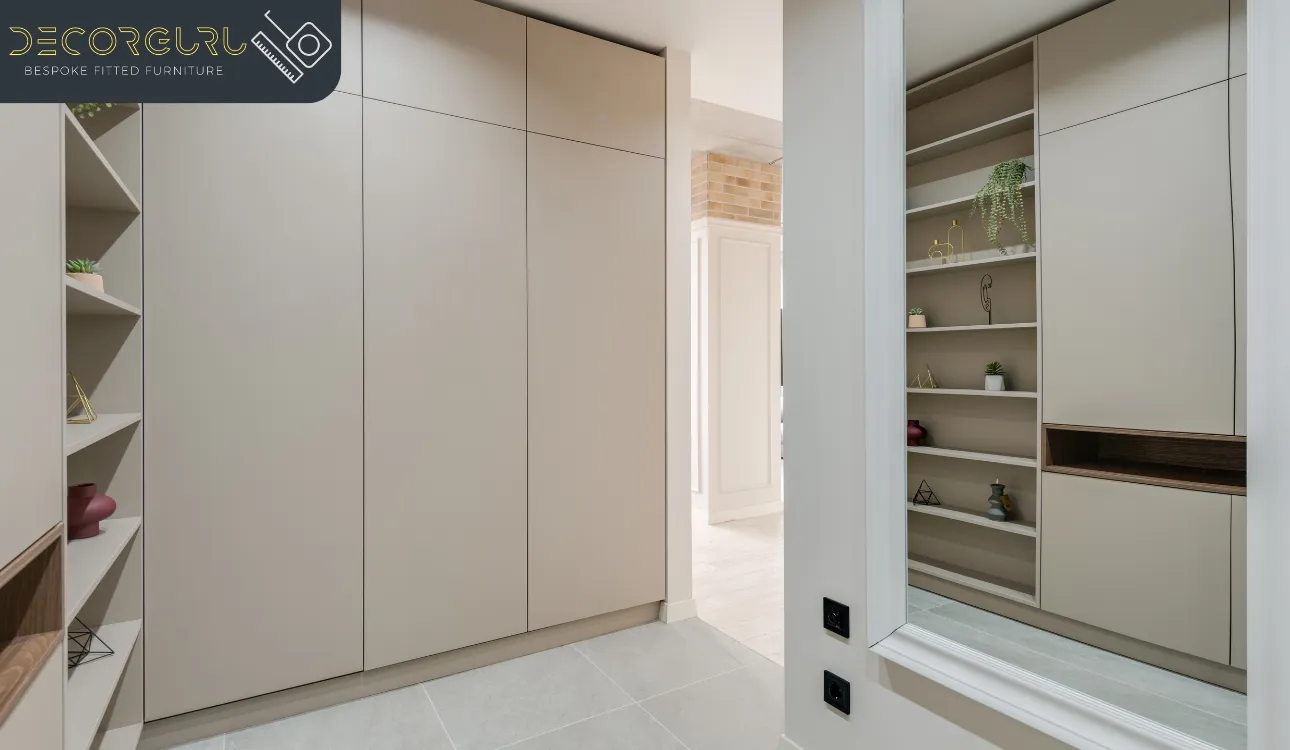
Going floor to ceiling also gives the room a cleaner, more built-in look. There’s no visual gap to break up the wall. It reads as architecture, not furniture.
This is especially valuable in fitted wardrobes for small rooms. A standard wardrobe gives you roughly 1.8m of hanging height . A floor-to-ceiling unit gives you 2.4 m; that’s 30-40% more storage in the same footprint.
6. Go Modular First: Upgrade to Bespoke When Ready
Here’s the honest advice that not many wardrobe companies will give you.
If your budget is genuinely tight right now, a phased approach works well. Start with a basic modular system configured to the layout you need, L-shaped or full wall. Then upgrade to a properly fitted solution when the budget is ready. Living with a layout for 6–12 months before committing to bespoke is actually smart.
You learn exactly how you use the space, what’s missing, and what you’d do differently. That knowledge makes the bespoke brief far sharper and the end result far better.
Then, when the budget is ready, a bespoke wardrobe fitter in Hertfordshire can replace the modular units with a made-to-measure solution using the exact layout you’ve already lived with and refined.
This phased approach works particularly well for:
- First-time buyers sorting out a new home on a tight budget
- Homeowners planning a larger renovation in the next 1–2 years
- Rental property landlords are improving a room without over-capitalising
The key: Don’t buy cheap units with poor runners or flimsy carcasses. Modular done well is a genuine stepping stone. Modular done cheaply creates frustration and ends up being replaced sooner.
Walk-In Wardrobe Solutions at a Glance
| Solution | Approx. Budget | Best For | Key Benefit |
| Alcove fitted wardrobe | £1,500–£2,500 | Older homes with chimney alcoves | Maximum use of dead space |
| L-shaped corner layout | £2,000–£3,500 | Spare rooms, large master bedrooms | Doubles usable hanging capacity |
| Landing conversion | £1,800–£3,000 | Wide landings, loft rooms | Creates new space from nothing |
| Sliding door upgrade | £300–£500 additional | All small rooms | Reclaims floor clearance |
| Floor-to-ceiling fittings | Included in any build | All rooms with 2.4m+ ceilings | 33% more storage, same footprint |
| Modular first, bespoke later | £600–£1,000 (phase 1) | Tight budgets, new builds | Low risk, upgradeable |
3 Things to Take Away From This
- You don’t need a big room. A 1.5m alcove, a wide landing, or a corner of a spare room is enough if the layout is right and the fittings are fitted properly.
- Sliding doors and floor-to-ceiling height are the two highest-value upgrades. Any small room wardrobe project. Both are cheap relative to the overall project cost, and both change how the space feels.
- Budget doesn’t mean compromise. It means being smart about where you spend. Start modular if you need to. Upgrade to bespoke when the time is right. Either way, your storage problem is solvable.
If you’re looking for walk-in wardrobe ideas for small rooms in Hertfordshire that actually fit your budget and your home. We’d love to help.
Book a free design consultation with Decor Guru Living We come to your home, look at the actual space, and tell you exactly what’s possible. Just honest advice and beautifully fitted wardrobes, built for real Hertfordshire homes.
People Also Ask
How small can a walk-in wardrobe be?
A functional walk-in wardrobe can work in a space as small as 1.5m × 1.5m. You won’t have a catwalk in the middle, but with well-planned fitted units along two walls and a sliding or curtain entry, it functions exactly like a full dressing room.
Are fitted wardrobes worth it in small rooms?
Yes. Often more so than in large rooms. In a small room, every centimeter matters. Fitted wardrobes are designed to the exact dimensions of the space, including awkward angles, sloped ceilings, and odd-shaped alcoves. Off-the-shelf units leave gaps. Fitted units don’t.
Can you have a walk-in wardrobe in Hertfordshire on a budget?
Absolutely. The key is knowing where to use modular solutions and where to invest in bespoke ones. An alcove wardrobe or a landing conversion using fitted units can deliver a genuine walk-in dressing experience for £1,500–£3,000 without structural work or planning permission.
What’s the difference between fitted wardrobes and bespoke wardrobes?
Fitted wardrobes are built to the shape of your room, floor to ceiling, wall to wall, but may use standard-sized carcasses and door panels. Bespoke wardrobes are made entirely to your measurements and specifications, including unusual dimensions, custom finishes, and unique internal configurations. Bespoke costs more but gives you a result no off-the-shelf product can match.